
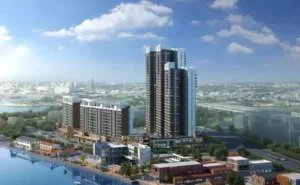
Real estate has property attributes and business attributes, and is a property of great value. Real estate is centered on real estate, and land price is the main component of real estate prices. The real estate industry is a collective term for the real estate industry and the real estate industry. It refers to an industry that uses land and buildings as business objects and engages in real estate development, construction, operation, management, maintenance, decoration and service economic activities. It mainly includes land development, paid allocation and transfer of land use rights, house construction, maintenance, management, house ownership sales, leasing and real estate mortgage loans, and the resulting real estate market.
The real estate market can be divided into primary, secondary and tertiary real estate markets. The primary market for real estate development is the market for the transfer of land use rights. It refers to the land that was originally raw land or rough land. Under the leadership of relevant government departments, it is organized or entrusted to primary land development enterprises with relevant qualifications, and is developed and organized into transferable land. The market of cooked land. The primary real estate market is a market monopolized by the state. The state is the core of the primary market and the most important market subject. It can be subdivided into four professional markets: land acquisition market, demolition market, land leasing market, and annual rent market. The secondary real estate market refers to the market where land users sell and rent newly built real estate after development and construction. That generally refers to the market formed when commercial housing enters the circulation field for transactions for the first time. The tertiary real estate market refers to a collection of markets where houses are transferred, mortgaged or leased based on the completion of secondary real estate development, such as the second-hand housing market, office building leasing, etc. Generally, our research focuses on the primary and secondary markets of real estate.
The real estate industry is classified according to its main business and can be roughly divided into: real estate investment and development industry, real estate brokerage industry, property management industry, real estate consulting industry, and real estate valuation industry.
Real Estate
Real estate investment and development industry: Real estate investment and development has the characteristics of large amount of funds, high rate of return, high risk, high added value, and strong industrial correlation. Most listed real estate companies are engaged in real estate investment and development. Major listed companies include: Country Garden, Vanke, Evergrande Real Estate Group, Poly Real Estate, Greenland Group, etc. Real estate brokerage industry: refers to the economic activities of engaging in intermediary, agency and other brokerage businesses for the purpose of collecting commissions and facilitating other people’s real estate transactions. Representative companies include: Centaline Real Estate, 21st Century Real Estate, I Love My Home, etc. The property management industry is an operational and enterprise-oriented management that repairs, maintains and manages houses, supporting facilities and equipment and related sites, and maintains environmental sanitation and related order in the property management area. According to the different uses of the places, they can be divided into residential properties, commercial properties, industrial properties and other properties. The real estate consulting industry and real estate valuation industry are also major real estate service industries, but they have not developed well in China for the time being.
There are other common classification methods for real estate, divided by use: residential real estate, commercial real estate, office real estate, tourism real estate, catering real estate, industrial real estate, agricultural real estate, special purpose real estate, and comprehensive use real estate. Categories according to development level: raw land, rough land, developed land, projects under construction, and existing houses. Categories according to property rights: state-owned, collective, private, shares, cooperation, foreign investment, etc. Categories according to business usage: sales, rental, self-operated and self-use.
Real estate industry introduction
Since the development of my country’s real estate industry, there have been four milestones, and its development process can be divided into four stages: exploration period, development period, rapid development period and transformation and upgrading period. The period from 1978 to 1993 was the exploratory period. This stage was the transitional stage from the planned economic system to the market economic system, and the commercial housing system was under exploration. After the reform and opening up policy, my country began to formally transform the planned economic system into a market economic system, and the real estate market-oriented system reform was officially launched. In June 1991, the State Council issued the “Notice on Continuing to Actively and Steady Reform of the Urban Housing System”, proposing that all public housing purchased at market prices will have full property rights after purchase. The period from 1994 to 2002 was the development period. During this stage, the government encouraged residents to purchase public housing and commercial housing, and introduced housing provident fund policies to reduce the burden of individual housing purchases and promote the market-oriented development of housing. In July 1994, the State Council issued the “Decision on Deepening the Reform of the Urban Housing System”, proposing to establish a new urban housing system to realize the commercialization and socialization of housing; to establish a housing provident fund system, etc.
The period from 2003 to 2015 was a period of rapid development. During this period, the competitive landscape of the real estate market gradually stabilized. Leading real estate developers began to conduct national layouts and implemented IPOs to expand financing channels. The scale of the residential real estate market achieved rapid growth. The period from 2016 to the present has been a period of transformation and upgrading. At this stage, the market has gradually matured and standardized, the growth rate of market size has slowed down, market concentration has tended to increase, and developers’ operations have tended to develop in the direction of deleveraging and maintaining quality. The Central Economic Work Conference at the end of 2016 proposed for the first time that “houses are for living in, not for speculation”, emphasizing the return to the residential function of housing.
Industrial chain
The industrial chain of the real estate industry involves many industries. The upstream is building materials suppliers, construction industry and financial industry, the midstream is real estate development, design, property management, etc., and the downstream is furniture, home appliances, home textile industry, etc.
The upstream industries include building materials suppliers, construction industry and financial industry. Building materials include structural materials, decorative materials, special materials, such as cement, glass, paint, paint, ceramics, steel, wood, etc. The main products of the building materials industry are cement, glass, and ceramics. The total contribution of these three sub-sectors to the sales revenue and profits of the building materials industry remains at more than 50%. As an important cementing material, cement’s main characteristics are product indifference and limited transportation radius. Therefore, cost control and cost transfer capabilities are the core competitiveness of the cement industry. my country implements a dual-track land supply system, that is, land supply is completed in two ways: the government allocates state-owned land to user units free of charge; it transfers state-owned land with compensation through market-oriented means. Currently, land is mainly transferred through three methods: bidding, auction, and listing. Land transfer revenue is an important source of government revenue. Real estate development requires huge financial support. The sources of funds for real estate development in my country are divided into domestic loans, use of foreign capital, self-raised funds and other funds. Among them, domestic loans are divided into bank loans and non-bank institutional loans; self-raised funds mainly include self-owned funds, bond financing, non-standard financing and equity financing, etc.; other funds mainly include deposits and advances, personal mortgage loans, etc.
The midstream industry includes real estate development, design, property management, etc. The main body is the real estate developer, which is responsible for the overall development of the project, purchasing construction materials and other raw materials, and bidding for construction companies to build finished residences and provide them to consumers. Real estate developers purchase land use rights from the government and borrow funds from financial institutions. Real estate developers must obtain corresponding qualifications to engage in corresponding development business. The Ministry of Construction of my country divides the qualifications of real estate development enterprises into four qualification levels according to the conditions of the enterprise. The scale of construction of real estate projects undertaken by real estate developers with first-level qualifications is not restricted. As the level decreases, the scale of projects that enterprises can undertake gradually decreases.
The downstream industry is the decoration and commercial leasing of finished houses, including the furniture industry, home appliance industry, home textile industry, decoration and decoration industry, commercial leasing and other industries. Different consumers of finished houses are different. According to the different needs of consumers for purchasing residential real estate, demand scenarios can be divided into three categories: rigid demand, rigid improvement demand, and improvement demand. Industrial real estate is developed with the purpose of promoting the development of local industries, including manufacturing, service industries, etc. Commercial real estate companies have close ties with brand owners, and the introduction of well-known brands is a reflection of their ability to attract investment, including catering, clothing, jewelry, supermarkets, etc.