
Has the U.S. economic recession finally arrived after the “violent interest rate hike”? Many people are interested in.
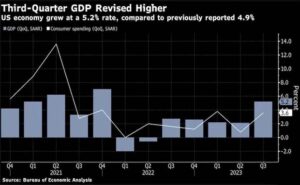
The latest statistics have arrived. In the third quarter of 2023, the real GDP growth rate in the United States was as high as 5.2%, achieving the “fifth consecutive increase” starting in the third quarter of 2022. Where has the promised recession gone?
After the release of this data, it caused a heated discussion in developed economies. After all, many developed economies outside the United States, especially European countries (including Eurozone members such as Germany and France), have also seen interest rate increases since the second half of 2022. But unlike the United States, most developed economies have seen interest rates rise less than the United States, but the former’s economic growth is either slower than that of the United States, or is on the decline.
Looking back at the latest round of interest rate hikes by the Federal Reserve, it began in March 2022 and lasted until May 2023. Since then, the Federal Reserve has not followed up with interest rate increases, but the federal funds rate has remained at a high of 5% to 5.25%, which is the highest level since the 21st century.
The U.S. economy after “violent interest rate hikes”
This wave of adjustments by the Federal Reserve was once considered a “violent interest rate hike”, and there was widespread criticism from both inside and outside the United States. After the second half of 2022, the “recession theory” became popular in domestic public opinion in the United States. The Federal Reserve has even been accused of causing the recession.
U.S Finance
A popular view at the time was that the U.S. economy was bound to fall into recession after the Federal Reserve raised interest rates sharply, and it was predicted that U.S. GDP would decline in the first or second quarter of 2023.
Indeed, judging from past U.S. economic data, interest rate trends are closely related to the economic cycle. Taking the quarter-on-quarter negative growth of real GDP as a criterion, in the more than 60 years from 1950 to 2010, a total of 10 economic recessions occurred in the United States. Every recession is preceded by rising interest rates in the U.S. economy.
As we all know, the 2008 financial crisis in the United States began with the subprime mortgage market crisis in 2007, and the direct cause of the subprime mortgage crisis was the multiple interest rate hikes by the Federal Reserve from 2004 to 2006. Looking further back to the 1991 recession, the federal funds rate, or the three-month federal bond yield, stayed at a high of over 6% for the two years before that.
Let’s look at a simple logic. For enterprises, an increase in interest rates means an increase in loan repayment costs and a decrease in net income from corporate investment, which makes enterprises less motivated to expand investment; for residents, due to liquidity constraints, the need to expand current consumer spending A large part of it depends on consumer loans, which includes increasing the purchase of housing and durable consumer goods; obviously, at a given income level, the level of interest rates is directly related to the total amount of loans that residents can borrow and the level of consumption that can be expanded.
However, this time the Fed operated as fiercely as a tiger, and the result was so abnormal!
Of course, you have to insist that from a long-term perspective, no country can avoid economic cycles; U.S. economic growth must encounter an “inflection point” at some point in the future, and its real GDP will decline. All I can say is that you are right.
Recently, there has been news that the Federal Reserve is about to turn “dovish”, and it is expected that in the first half of 2024, as inflation continues to fall from 3.2% in November 2023. If the news is true, even if an economic recession occurs after an interest rate cut, it will be difficult to use interest rate policy to take the blame. Clearly, something different is happening in the United States.
We won’t delve into the reasons behind this here. For most people, knowing the results is enough. In this turbulent world, it is precious to see some truth behind the chaos.
For most people who want to immigrate to the United States quickly, the best paths are EB1-A and EB-5. Among them, EB1-A has relatively high requirements for applicants, so the only remaining path is EB-5.
According to the EB-5 new policy launched by the Biden administration in 2022, foreign immigrant applicants who invest in the United States to establish commercial enterprises that are beneficial to the U.S. economy and create 10 jobs indirectly or directly can be issued a two-year conditional green card. 90 days before the expiration of the two-year period, if the immigrant investor behavior still exists, you can apply for “conditional removal” and become a permanent resident.
On March 15, 2022, President Biden signed the EB5 Regional Center Act with the stroke of a pen, extending the above bill to September 30, 2027.
Even more impressive is that if the reserved quotas for the current year are not used up, the unused visa quotas will be added to the second year reserved for the same category. If they are not used up in the second year, they will be released. For use by other EB-5 applicants.
In fact, the EB-5 new policy has several remarkable advantages. If you want to have a comprehensive and in-depth understanding of the latest EB-5 investment process and projects and avoid investment risks, please stay tuned to our website for the latest information.